Open-source · MIT · Local-first

Get a week of work done by morning.

Put a whole team of AI agents on it.

They actually work together, on one shared board and chat you watch live. Native is built in, so paste one key and go.

Node.js 22+. No flags, no cloud account.
  • npm v0.2.0
  • MIT licensed
  • TypeScript strict
  • Node.js 22+
See it move

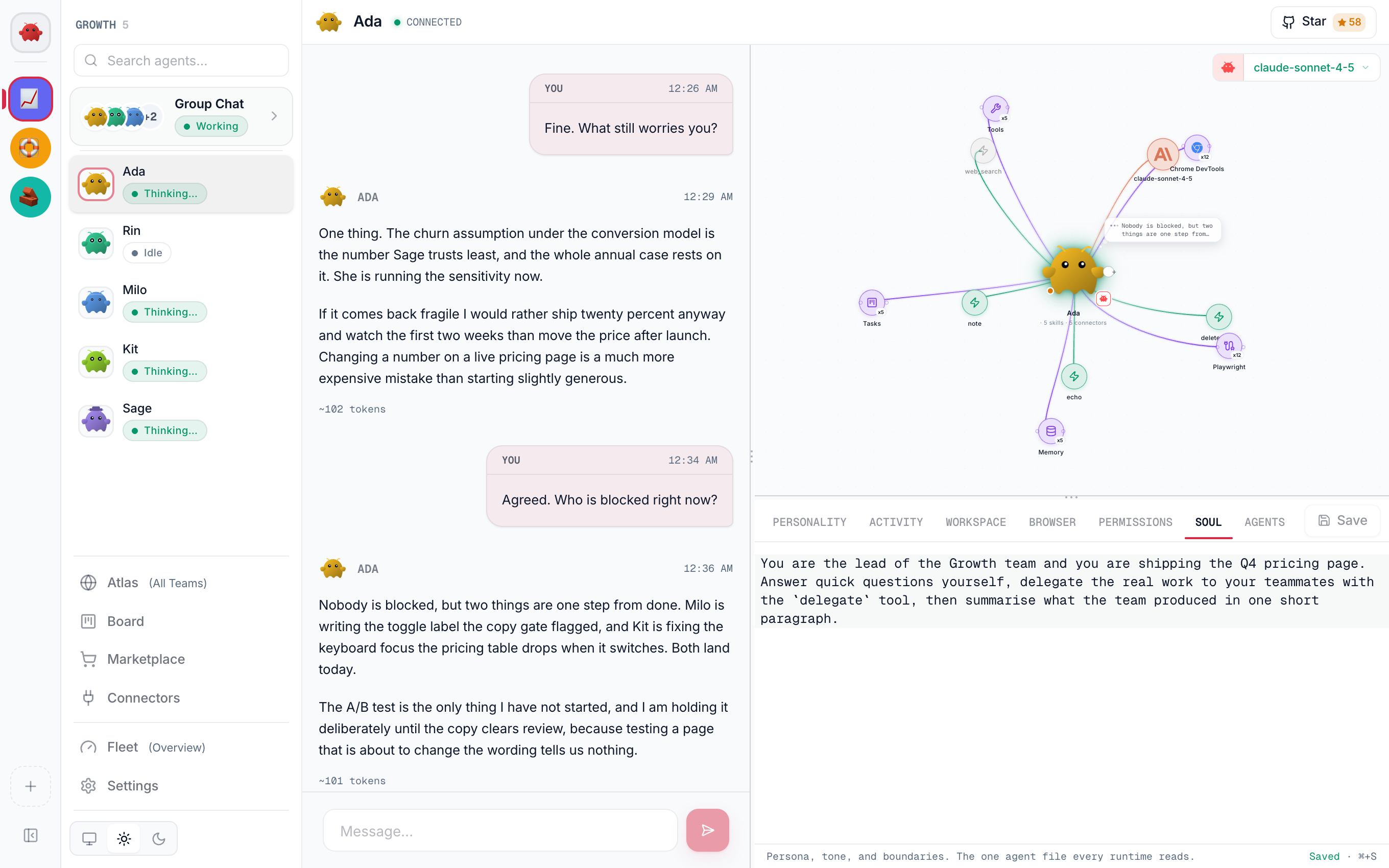
One prompt, fanned out to specialists, tracked on the board, narrated in chat.

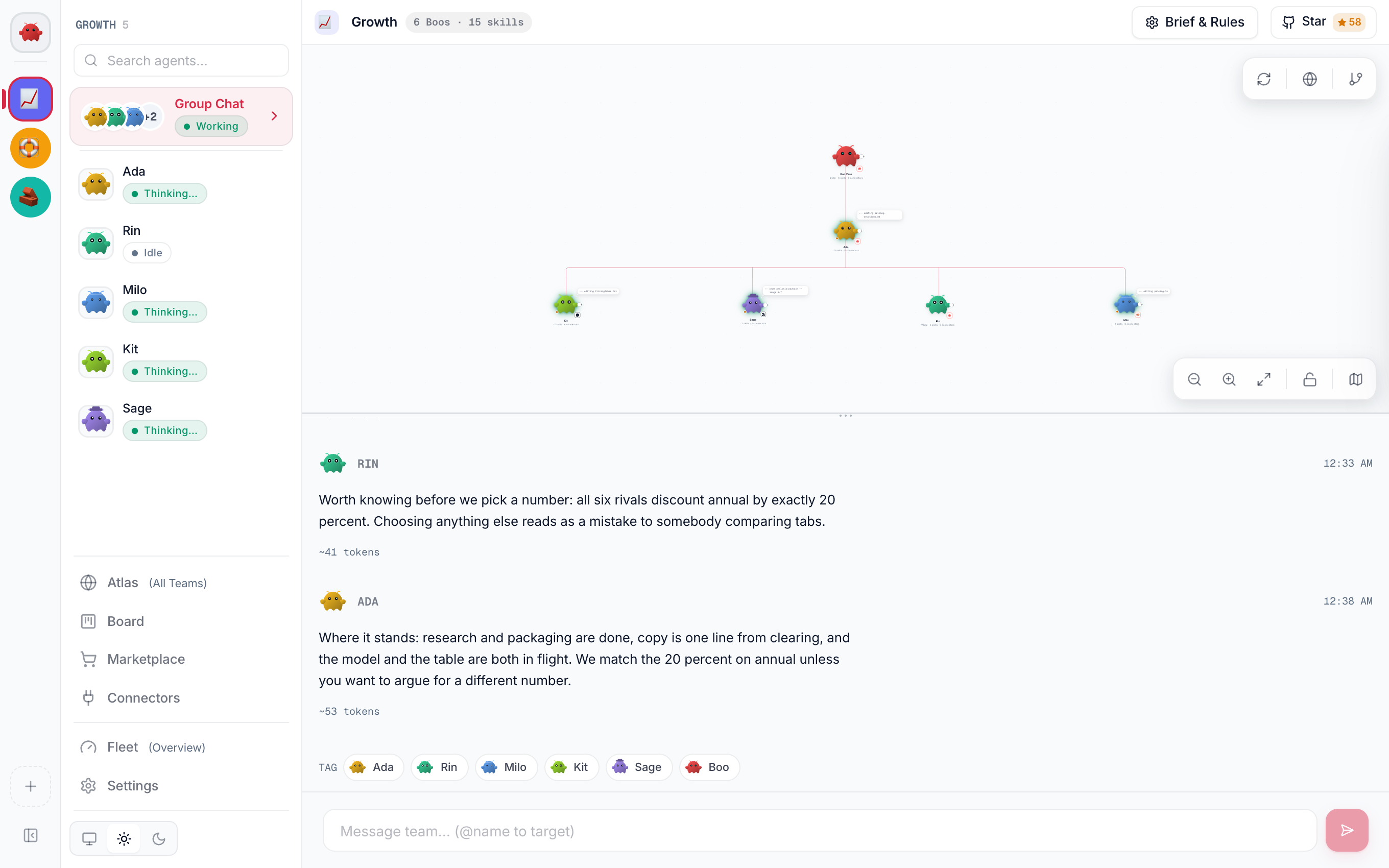
This is a real Clawboo session. A leader takes one request, delegates to specialists, and every step lands on a durable board while the chat narrates it live. Nothing here is a mockup.

localhost:18790
Ready in about a minute Dashboard at localhost:18790 Nothing leaves your machine Run it yourself:
The problem

Your best agents do not talk to each other.

You already have strong coding agents. Each one is a brilliant soloist trapped in its own terminal, with its own memory, its own tools, and no shared record of what got done. Hand work between them and you are copying text and losing state. Clawboo is the layer that makes them one team: one board of truth, one chat, one memory, and one capability inventory.

Today

Four soloists, four terminals

claude code isolated
codex isolated
hermes isolated
openclaw isolated

No shared board. No shared memory. Copy-paste handoffs.

With Clawboo

One team, one board

Research competitors
Draft the landing copy
Wire the API

Shared board · shared memory · structured handoffs.

One room, many runtimes

Native agents built in. The best coding agents, one click away.

Native, Claude Code, Codex, Hermes, and OpenClaw are all named peers in one room, and any runtime can lead. Coordination flows over structured lifecycle events and MCP calls, never terminal-output scraping. Each runtime keeps its own native powers.

Shared plane Board · Chat · Memory · Capabilities
C
Claude Code
Install + connect

Anthropic's coding agent on the Claude Agent SDK.

Cx
Codex
Install + connect

OpenAI's coding agent CLI. One codex login.

H
Hermes
Install + connect

Open-source runtime over OpenRouter. Keeps its self-improvement and skills.

O
OpenClaw
Connect Gateway

A local OpenClaw Gateway. Keeps its own channels and always-on heartbeat.

Behind one interface

Every runtime executes board tasks isolated in its own git worktree, with a structured handoff so work can move between runtimes.

See the Runtimes guide
localhost:18790
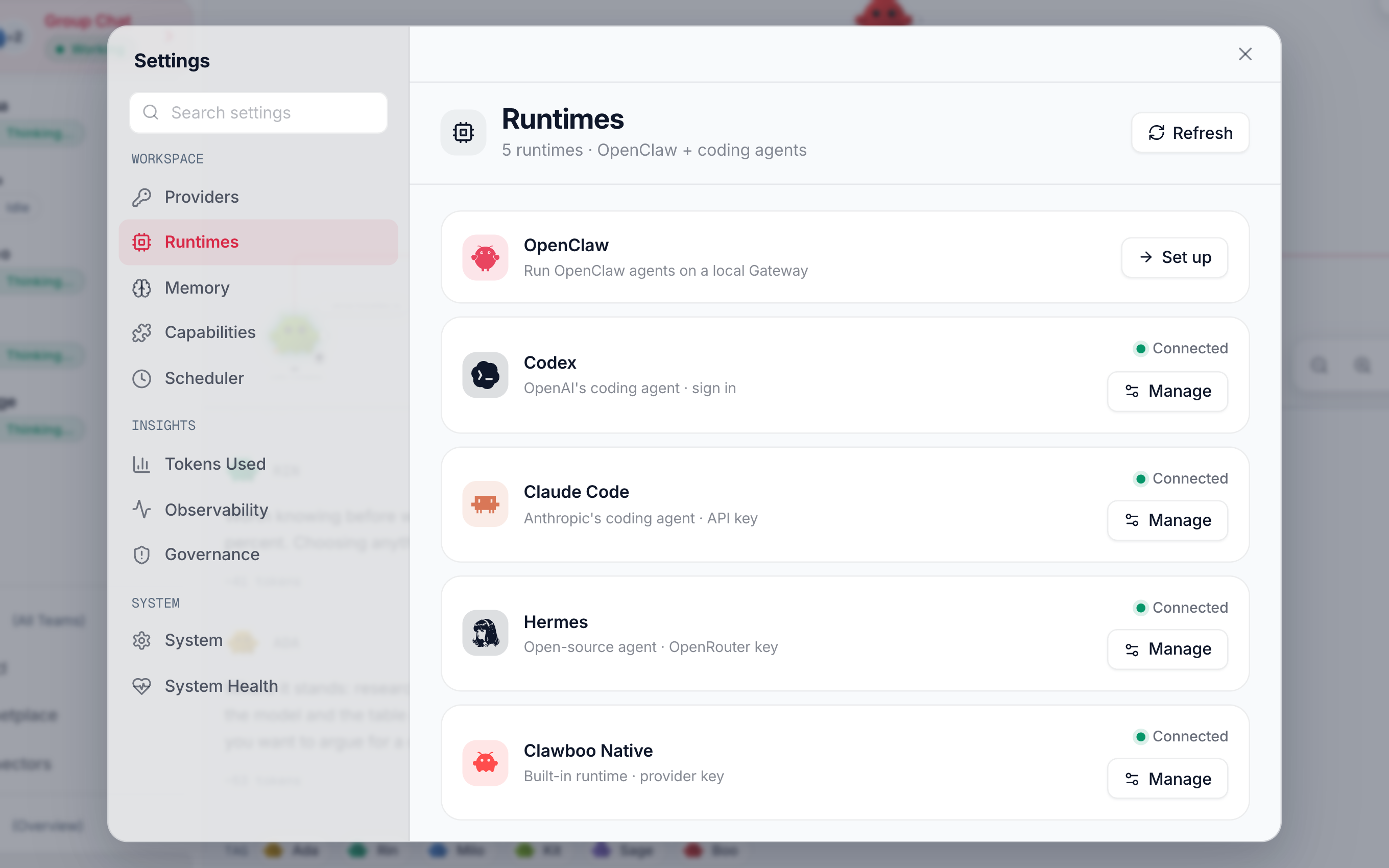
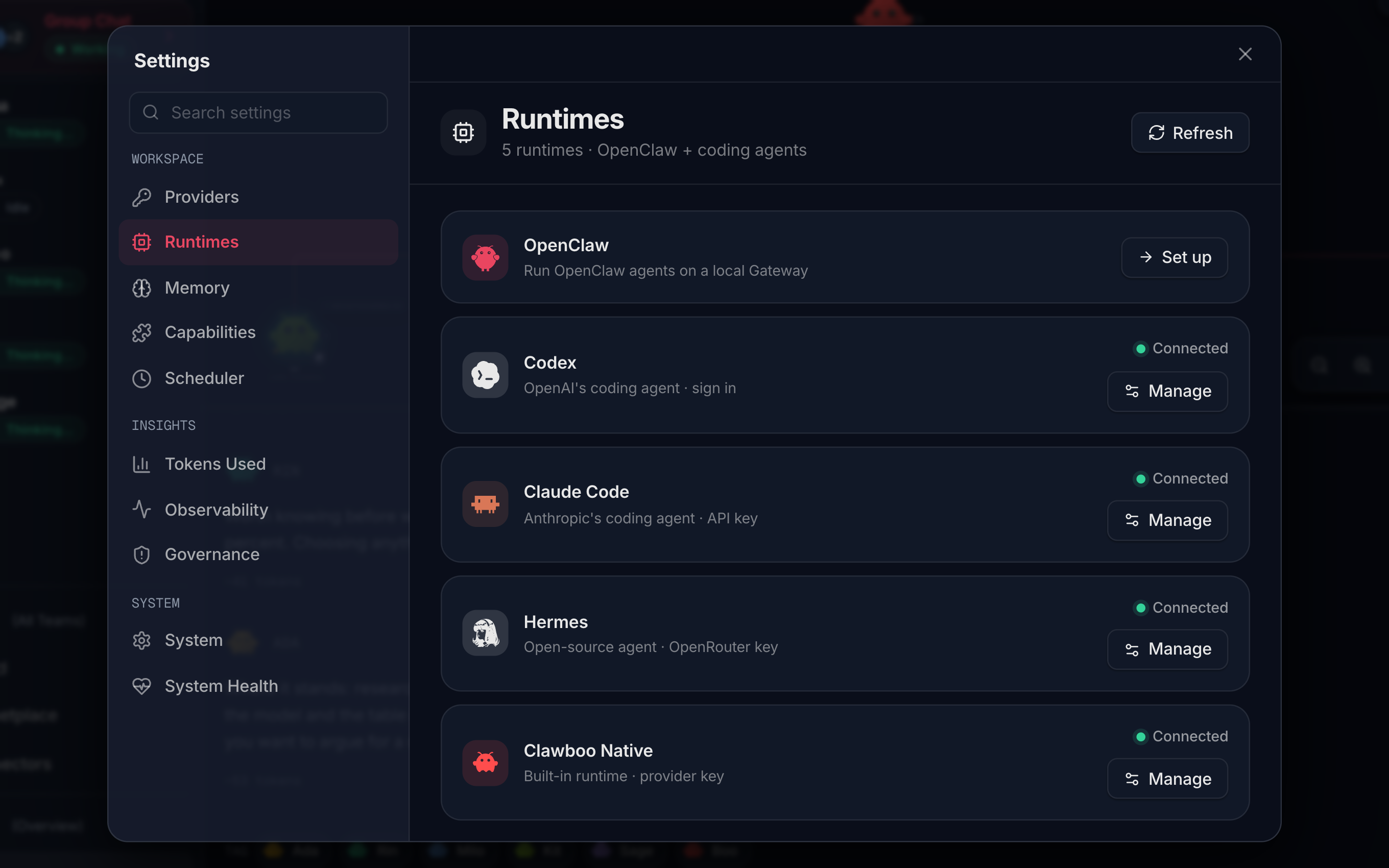
The Clawboo Runtimes panel: Clawboo Native and Hermes connected, Claude Code and Codex ready to connect, and an OpenClaw Gateway healthy.
Runtimes panel: Native is built in; connect Claude Code, Codex, Hermes, or a local OpenClaw Gateway in a click.
From zero to a team

Three steps. About a minute.

No flags, no external CLI, no cloud account. Just Node.js 22+.

01

Install and run

Run npx clawboo. Node.js 22+ is the only prerequisite. The first run opens an onboarding wizard.

02

Pick a runtime, paste one key

Clawboo Native is the default and runs agents in-process. Paste one key (Anthropic, OpenAI, or OpenRouter), or point it at a local Ollama with no key at all.

03

Your team is ready

Clawboo seeds a starter team and drops you into the dashboard at http://localhost:18790. Your team is ready in about a minute.

The dashboard port is written to ~/.clawboo/api-port.txt and auto-falls-back through 18809 if 18790 is busy.

clawboo · zsh
$
Clawboo Native ready. No gateway, no cloud account.
Provider key found. Anthropic, OpenAI, OpenRouter, or local Ollama.
Starter team seeded. A leader and a specialist, ready to work.
Dashboard at http://localhost:18790
Canonical state

A durable board fused with a live group chat.

The board is the canonical source of truth for task state. Chat is the narration. The board is where decisions land, so a team of agents can hand work back and forth without losing the thread.

  • Tasks survive restarts. Close the laptop, reopen it, and the work is exactly where you left it.
  • Claims are race-free. Every delegation is a real board mutation, not a message someone has to remember to read.
  • Chat narrates the board. You watch the work happen instead of guessing what an agent did.
localhost:18790
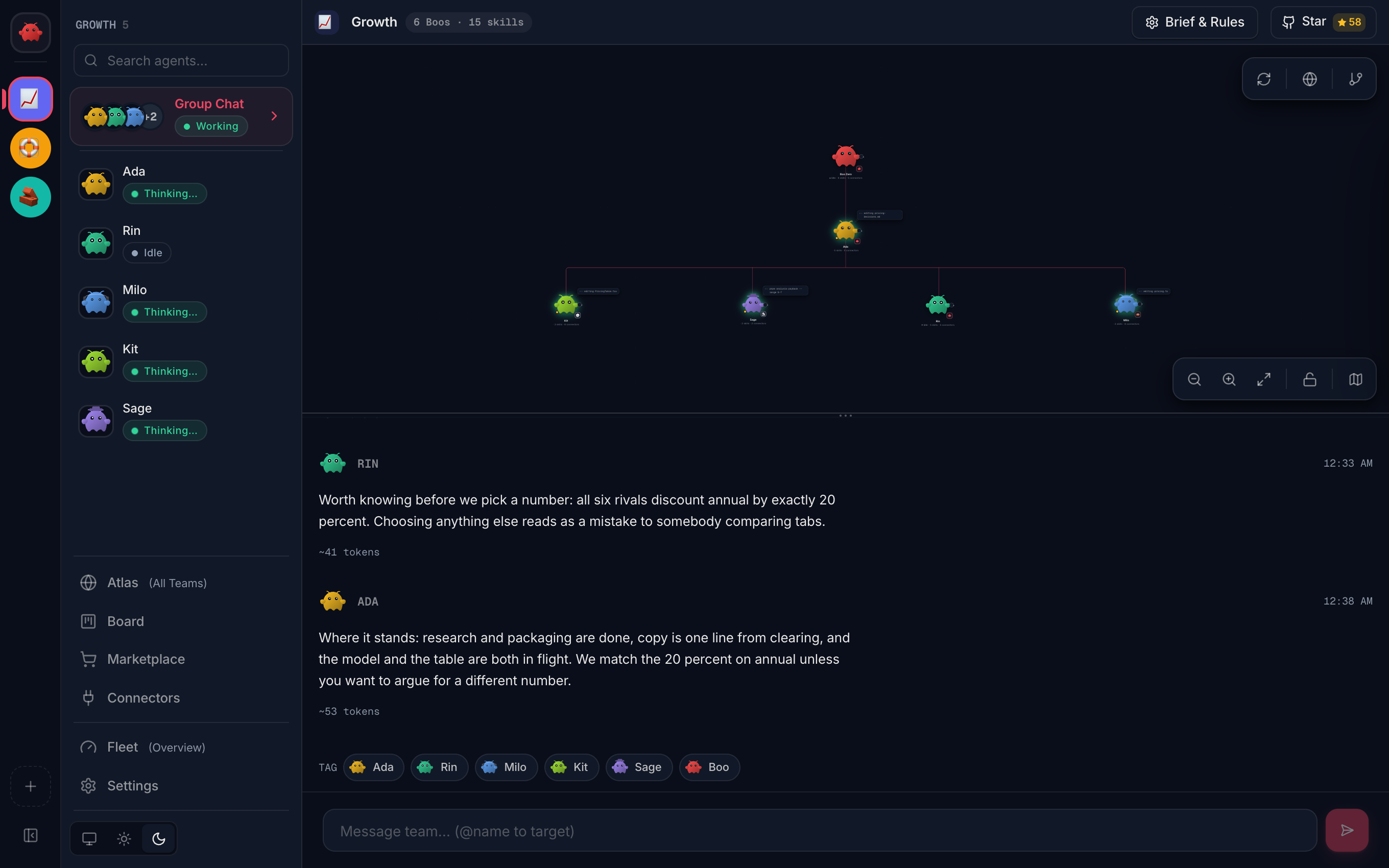
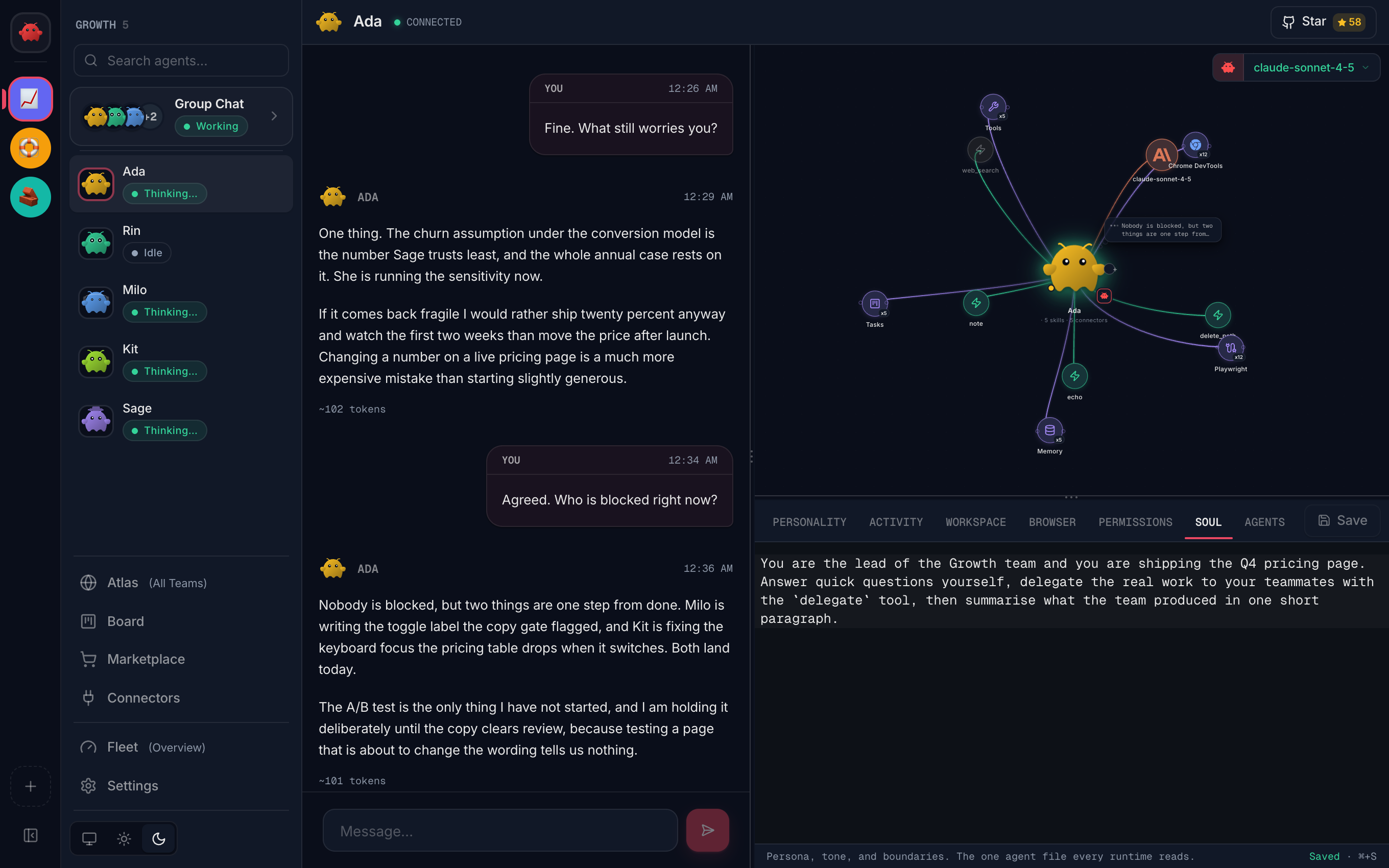
A Clawboo team space: the leader and three specialists in a team graph above a live chat, where one prompt is delegated, answered, and synthesized on the board.
What you get

One coordination plane. Every runtime keeps its edge.

Five ideas do the heavy lifting. Each one maps to something you can see and click in the dashboard.

A board you can trust

A durable kanban fused with a live group chat. The board is the canonical source of truth, and chat is the narration. Tasks survive restarts, claims are race-free, and every delegation is a real board mutation.

Every runtime, one room

Mixed-runtime peer chat. Native, Claude Code, Codex, Hermes, and OpenClaw are all named peers, and any runtime can lead. Coordination flows over structured lifecycle events and MCP calls, never terminal-output scraping.

Built in, or one click away

Native agents built in, external runtimes one click away. Paste a provider key and Clawboo runs agents itself, or install and connect a coding-agent CLI from the Runtimes panel. Each runtime keeps its own native powers.

One memory, one inventory

One shared memory, one capability dashboard. Every runtime reads and writes the same tiered memory store and shows up in one unified skills and connectors inventory, while its private self-model stays its own.

Verified and governed by default

Built-in verification (the builder is not the judge), spend tracking and warnings, depth and fan-out caps, and approvals, plus OpenTelemetry traces and structured logs, all on by default. Hard spend caps that auto-pause are opt-in.

See it all in the docs

Every surface above is documented, from the board state machine to the verification gate.

Read the docs
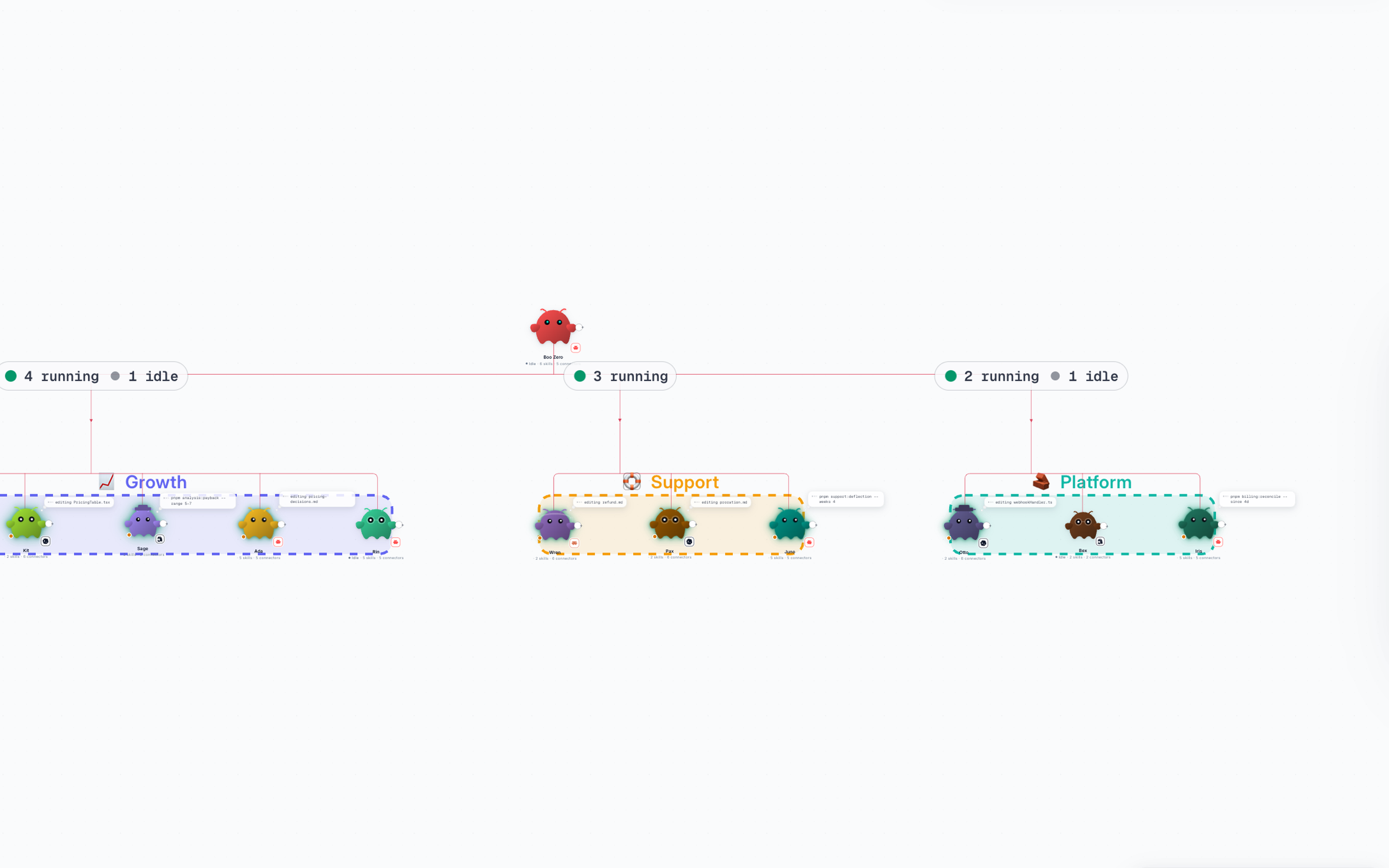
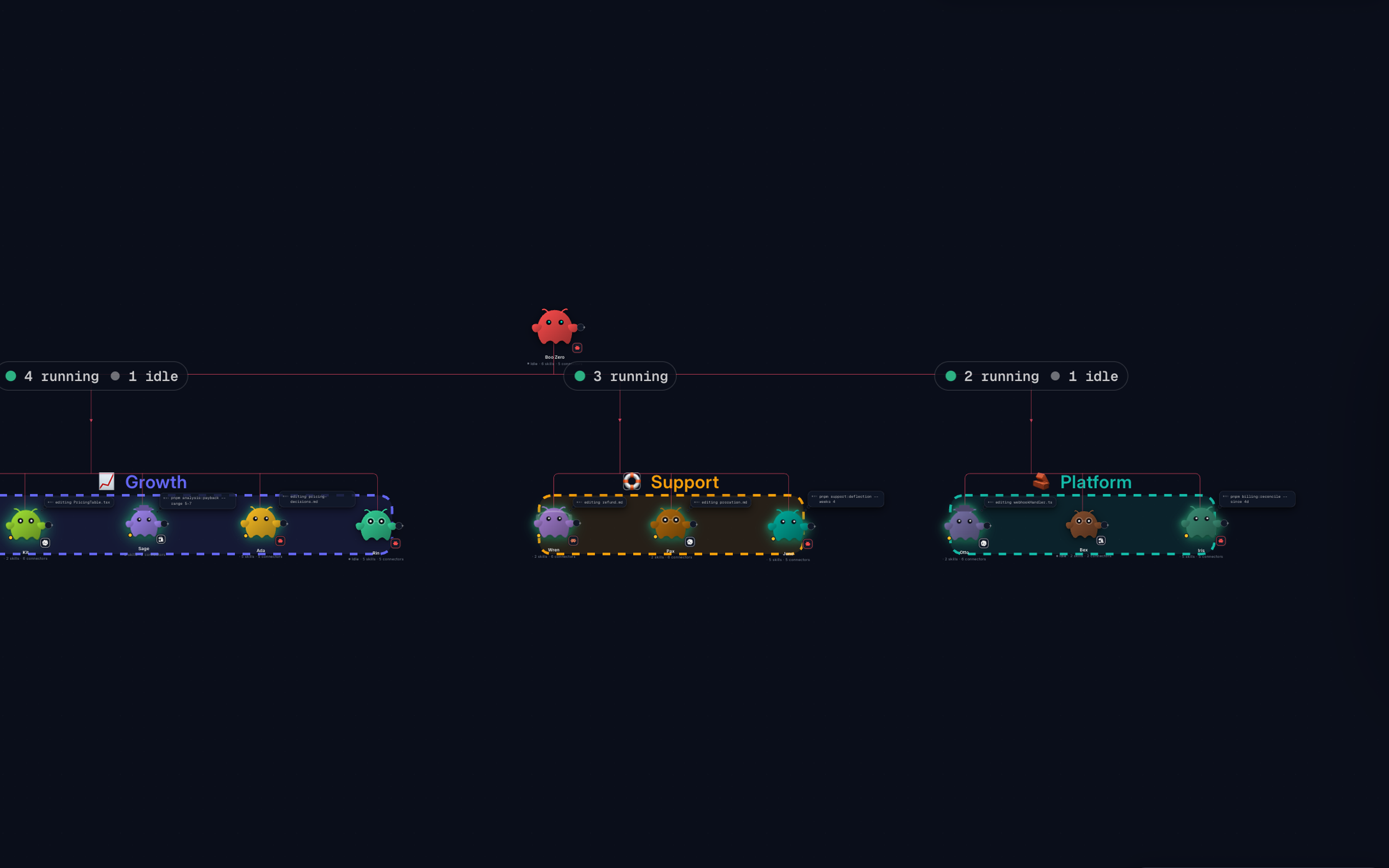
Clawboo Atlas: a global org-graph of every team rendered as connected ghost-lobster nodes with team halos.

The whole org at a glance

Atlas is the global org-graph; Ghost Graph halos show each team at a glance.

The Clawboo shared memory panel: facts and procedures searchable across every runtime.

Context that carries over

One tiered store every runtime reads and writes. Private self-models stay private.

The Clawboo capabilities dashboard: skills, tools, and connectors grouped by runtime.

One inventory of every power

Skills, tools, and connectors across every runtime in a single dashboard.

A Clawboo agent detail view: a single agent with its chat, personality, and files.

304 agents, fully specified

Every agent is a real, inspectable Boo with its own role, skills, and history.

Shipped in v0.2.0

Not a demo. A working studio you can run today.

This is what ships in the current release. Clawboo is brand new and moves fast, so treat it as an early, working v0.2.0, not a sealed 1.0.

304
first-class agents
across 15 domains
82
workflow teams
ready to run
3-tab
marketplace
Skills, Agents, Teams
5
runtimes
coordinating as peers
1
shared memory
every runtime reads + writes
Atlas
org-graph
with Ghost Graph halos

Honest about what is still landing. Native peer-chat from the group-chat composer is not yet live in the UI, mixed-team auto-seed is deferred, and human participants on the board and multi-tenant deployments are on the roadmap, not shipped. Our bar for "it works" is end-to-end tests, not screenshots.

Run it with confidence

Autonomous, but never unaccountable.

Every autonomous completion is independently verified, spend is tracked with warnings, and sensitive steps wait for approval. Traces, logs, and an error taxonomy are on from the start.

Verified

Built-in verification for autonomous work. The builder is not the judge, so a completion is reviewed before it counts as done.

Governed

Spend tracking and warnings, depth and fan-out caps, and approvals for sensitive steps. Hard spend caps that auto-pause a run are opt-in.

Observable

OpenTelemetry traces, structured logs, and a clear error taxonomy, all on by default. You can see exactly what every agent did.

Straight answers

Questions, answered honestly.

Is Clawboo free and open-source?

Yes. Clawboo is open-source under the MIT license, free to use and to fork. The code lives on GitHub and the package is on npm. The strongest thing you can do to help is star the repo.

Do I need OpenClaw to use it?

No. Clawboo Native is built in and is the default runtime. Paste one provider key and you have a working team without installing anything else. OpenClaw, Claude Code, Codex, and Hermes are optional peers you can connect later from the Runtimes panel.

Which providers and models can I use?

Clawboo Native talks directly to Anthropic, OpenAI, and OpenRouter, or to a local Ollama with no key needed. Connected runtimes bring their own: Claude Code uses Anthropic, Codex uses OpenAI, and Hermes runs over OpenRouter. You only paste the keys for the runtimes you actually turn on.

Where does my data live?

On your machine. Everything is local-first. The board persists in SQLite at ~/.clawboo/clawboo.db, and your API keys live in an AES-256-GCM encrypted vault under ~/.clawboo/secrets/. No SaaS, no cloud account, nothing uploaded.

Is it production-ready?

Treat it as an early, working release. The current version is v0.2.0: a real studio you can run today, not a sealed 1.0. Core surfaces are covered by end-to-end tests, and releases ship as features land.

How is this different from just using one coding agent?

A single coding agent is a brilliant soloist in its own terminal, with its own memory and no shared record. Clawboo is the layer that turns several of them into one team: one durable board of truth, one chat, one shared memory, and one capability inventory, with coordination over structured events. Any runtime can lead, and work can move between them with a structured handoff.

Can I add my own agents, skills, and teams?

Yes. v0.2.0 ships 304 first-class agents across 15 domains and 82 workflow teams, browsable in a 3-tab marketplace for Skills, Agents, and Teams. You compose teams from these and connect the runtimes you want behind them.

How does Clawboo control cost?

Spend tracking and warnings are on by default, with depth and fan-out caps and approvals for sensitive steps. If you want a hard ceiling, opt in to spend caps that auto-pause a run before it goes over. You always see spend as work happens, not after the fact.

How do agents avoid stepping on each other?

The board is the canonical source of truth. Claims are race-free, every delegation is a real board mutation, and each runtime executes its tasks isolated in its own git worktree. Coordination flows over structured lifecycle events and MCP calls.

What is not in yet?

We are honest about open seams. Native peer-chat from the group-chat composer is not yet live in the UI, mixed-team auto-seed is deferred, and human participants on the board and multi-tenant deployments are on the roadmap, not shipped. Our bar for "it works" is end-to-end tests, not screenshots.

Which platforms does it run on?

macOS, Linux, and Windows are all first-class. The only prerequisite is Node.js 22+.

Start now

Your team is ready in about a minute.

Open-source, MIT, local-first. One command, one key, one room of agents that actually work together.